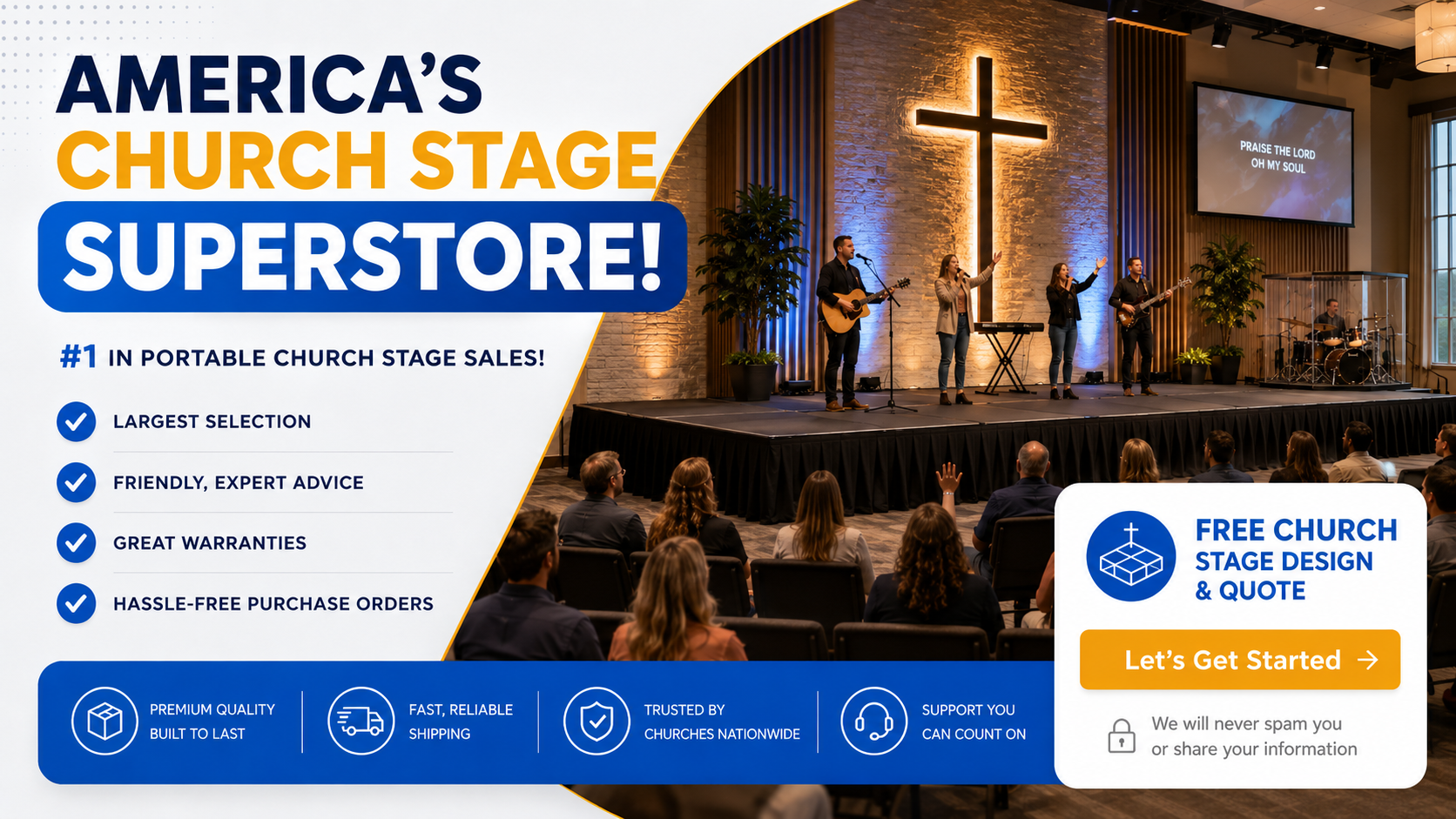
Shop portable church stages for worship services, sermons, praise bands, choir performances, youth ministry and community events. The Stage Depot helps churches, synagogues, temples and other houses of worship compare lightweight modular, folding-leg, mobile and outdoor staging systems around your space, setup crew, storage, access needs and budget.
For more than 20 years, portable staging has been our specialty. We help your congregation choose around your worship services, setup crew, storage space, access requirements and budget. Whether your volunteers build a worship platform every week in a rented school or your congregation needs a stage that stays assembled in a sanctuary, we can help you plan a suitable system and complete layout.
- Free expert stage planning
- Purchase orders accepted
- Tax-exempt purchasing supported with valid documentation where applicable
- Manufacturer warranties and dedicated U.S. support
Start with StageMatch™: 30 seconds | 5 quick questions, or call 877-884-3426.
Church staging for worship services and shared spaces
A portable worship stage lets you change the room layout as your activities change. A fellowship hall can host a service, a youth program and a community meeting using different arrangements of compatible platforms. A stage can also provide a finished appearance with skirting while remaining removable.
| Church or worship use | What to plan |
|---|---|
| Sermons, readings and presentations | Lectern space, speaker visibility, stage height and comfortable access. |
| Praise bands and music ministry | Drums, keyboards, amplifiers, microphone stands, cables and room to move between positions. |
| Choir performances | Standing or seated arrangements, tier depth, sightlines and appropriate edge protection. |
| Portable churches and rented venues | Weekly setup, trained volunteers, floor protection, loading routes and storage or trailer space. |
| Youth ministry and seasonal productions | Performer movement, scenery and the demands of dancing, jumping or rolling equipment. |
| Outdoor services and outreach | Ground conditions, leveling, deck construction, weather exposure and the complete event layout. |
What size portable stage does your church need
Size the stage around the people and equipment using it at the same time. A congregation's attendance does not tell you how much room a worship team needs onstage. Lay out the drum kit, keyboard, lectern, chairs and movement areas before choosing the footprint.
| Example stage size | Area | Layouts to explore |
|---|---|---|
| 8 ft × 8 ft | 64 sq. ft. | Compact speaking platform or a dedicated instrument area, subject to the actual equipment footprint. |
| 12 ft × 8 ft | 96 sq. ft. | Lectern and presentation space or a small music arrangement. |
| 16 ft × 12 ft | 192 sq. ft. | A compact worship-band layout with room allocated to instruments and circulation. |
| 24 ft × 12 ft | 288 sq. ft. | A wider worship platform with separate speaking and music positions. |
| 24 ft × 16 ft | 384 sq. ft. | More depth for musicians, seated participants or a seasonal production. |
| Custom layout | Varies | A sanctuary extension, combined stage and risers, or a room with unusual dimensions. |
These are planning examples, not performer-count or load-capacity guarantees. Stairs, ramps, landings and entrances need space beyond the stage footprint. For systems using 4 ft × 4 ft decks, a rectangular 16 ft × 12 ft stage uses 12 platforms; other platform sizes require different quantities.
Send us a room sketch and your intended layout. We can help compare dimensions and identify the accessories needed for a complete package.
Compare portable stage systems for your church
Choose the construction and handling method that suit your ministry. A label such as “church stage” describes an application; it does not identify the support design, load rating or storage requirements.
| Stage system | Features to compare | Church applications to discuss |
|---|---|---|
| Easy-Lite IntelliStage® | Separate lightweight decks and collapsible accordion risers; compact component storage. | Frequent reconfiguration, small storage rooms and indoor worship layouts on suitable level floors. |
| EZ-Lock QuickLock™ | Removable fixed, telescoping or caster legs; specified waterproof aluminum-deck options. | Adjustable layouts, selected mobile risers and locations requiring leveling within the system's limits. |
| ProFlex Feather-Lite™ | Integrated folding legs, 16–24 inch adjustment and flat storage; designed for lighter-duty uses. | Presentations and portable setups where manageable components and fewer loose parts matter. |
| Staging 101™ | Steel folding platforms with attached legs and selected fixed or dual-height configurations. | Shared indoor rooms and congregations comparing a traditional folding stage. |
| Executive Tri-Height Mobile Folding | Rolling folding sections with 8, 16 and 24 inch working heights. | Repeated room changes where the storage route accommodates rolling sections. |
| Pro-Stage Heavy Duty | Modular aluminum platforms, adjustable-leg configurations and specified bracing. | Demanding productions, larger performance layouts and taller configurations. |
| All-Terrain™ | Independent leveling and terrain components; weather-resistant or waterproof aluminum-deck choices. | Outdoor services on grass, slopes, curbs or other uneven sites within approved system limits. |
For a budget-focused indoor purchase, also compare Economy Executive stage kits. Tell us about concentrated loads such as a piano, drum riser, equipment rack or rolling cart, as well as any dancing or jumping. A uniformly distributed load rating alone does not establish suitability for every activity.
Choose a stage your volunteers can move and store
For weekly setup, consider the entire route from storage to the worship area. A section that rolls easily across a gym floor may still need to cross a threshold, turn through a narrow door or be lifted into a trailer. “Tool-free” assembly does not eliminate lifting, connecting sections or installing accessories.
Before choosing a system, check:
- The number of trained adults normally available and the weight and dimensions they can handle.
- The narrowest door, corridor, elevator or storage-room entrance on the route.
- Whether platforms must be carried, rolled, transported in a vehicle or moved between campuses.
- The packed dimensions of decks, legs or risers, rails, stairs and carts.
- The venue's floor-protection requirements and where equipment can be stored securely.
Use the manufacturer's setup instructions, label compatible components and keep a photographed layout with the equipment. Rehearse the full setup and teardown before the first service. Assign someone to check connections, supports, access and cables before the stage is used. Plan for accessories and inspection when estimating the available setup window.
Choir risers and drum platforms for music ministry
A flat worship stage, standing choral risers and seated choir risers serve different purposes. Standing choir risers provide stepped positions for singers. Seated arrangements must accommodate chairs, music stands, movement and suitable chair stops or edge protection. Compare choral and choir risers around the actual arrangement you need.
For a drum platform, measure the full kit, drummer's seat, cymbal stands and access area. Elevation can improve visibility, but it does not by itself isolate sound or reduce stage volume. If a drum riser will roll, use a manufacturer-approved mobile configuration and follow its locking and occupancy instructions.
Stage height and accessible access
Choose height around sightlines, room depth and the people who need to use the stage. Compare lower 8 or 16 inch configurations for compact rooms, and evaluate taller options when the layout requires them. Extra height also changes the stairs, guards, ramp space and handling plan.
Include access for clergy, speakers, musicians and participants with mobility needs at the start of the design. At a 1:12 slope, a 24 inch rise needs 24 feet of horizontal ramp run before adding landings. This is a planning calculation, not a complete compliant ramp design. Width, handrails, edge protection, landings and applicable local requirements also matter. Review the U.S. Access Board's ramp guidance and explore compatible stage ramps.
A ramp sold as an accessory does not establish compliance for the entire installation. Confirm the requirements for your venue and event with the appropriate local authority.
Outdoor stages for church services and outreach
For outdoor worship, tell us whether the site is pavement, grass, a slope or a surface with curbs. The supporting ground, leveling method and approved bracing matter as much as the deck finish. All-Terrain is an option to explore for uneven sites; EZ-Lock offers selected adjustable configurations and waterproof aluminum decks.
Weather-resistant wood-core decks and waterproof all-aluminum decks are different products. Select the exact construction for the expected exposure and follow the manufacturer's drying, covering and storage instructions. Waterproof decks do not make an outdoor event safe in every weather condition. Review the site and weather plan with the people responsible for the event.
How much does a portable church stage cost
Compare the finished package, including the footprint, height, surface, stairs, guards, access and storage equipment. These specific 8 ft × 12 ft examples illustrate different starting prices; they are not equivalent packages.
| Stage system | Example configuration | Listed kit price |
|---|---|---|
| Economy Executive | 12 ft × 8 ft, 8 inch height, hardboard finish | $1,593 |
| Easy-Lite IntelliStage | 12 ft × 8 ft, 8 inch height | $2,328 |
| Pro-Stage Heavy Duty | 12 ft × 8 ft modular kit; confirm selected options | $3,412 |
| ProFlex Feather-Lite | 8 ft × 12 ft, 16–24 inch adjustable height, industrial finish | $3,984 |
| All-Terrain | 12 ft × 8 ft, 24–48 inch configurations, weather-resistant decks | $6,452 |
Example listed prices reviewed October 8, 2026. Heights, finishes and included components differ. The All-Terrain example is not the waterproof aluminum-deck package. Freight applies to the linked Economy Executive example. Confirm current prices, accessories, delivery charges and applicable tax before ordering.
Funding options and resources for church staging
Begin with a defined equipment project and an itemized quote. Explain who will use the stage, where it will be stored and which activities it will support. Funding rules depend on the organization, intended use and specific program; an organization's nonprofit or religious status does not automatically make a stage purchase eligible.
Church equipment budgets and donor campaigns
Ask your leadership or finance committee about an approved facilities, worship, music or equipment allocation. A donor campaign can set a concrete goal covering the platforms, supports, access, accessories and delivery. If you plan to expand later, choose compatible components and confirm that the initial package is complete for its intended use.
Document shared uses such as services, music rehearsals, youth activities and community events. Keep donor restrictions and the responsible department clear when several ministries contribute.
Denominational resources and equipment financing
Ask your denomination, regional body or affiliated foundation about equipment grants, capital campaigns and loan funds. Eligibility and permitted purchases vary.
For example, the ELCA Mission Investment Fund offers loans to eligible ELCA congregations and related ministries, including options for smaller capital projects. Its congregational loan application guide includes furnishings and equipment in building-project budgets. Ask MIF whether your specific staging purchase fits an eligible project. These are loans, not grants.
You can also explore the financing resource linked by The Stage Depot. Ask the lender about church eligibility, total repayment cost, fees and terms before committing; approval is not guaranteed.
Local foundations and community partners
For staging that supports public arts, youth or other community programming, look for local funders whose priorities match that activity. Use the Council on Foundations Community Foundation Locator to identify organizations in your area. Each funder determines whether it accepts faith-based applicants, supports religious activities or permits durable equipment purchases. Confirm all three before applying.
USDA funding for eligible rural community facilities
The USDA Community Facilities Direct Loan and Grant Program can support equipment for eligible essential community facilities in rural communities with no more than 20,000 residents. Eligible applicants include community-based nonprofit corporations.
Faith-based organizations may participate when otherwise eligible, but USDA direct assistance generally cannot support worship, religious instruction or proselytization. Shared equipment costs must be allocated between eligible and ineligible uses under the applicable rules. A stage used for services is not automatically an eligible community-facility purchase. Review USDA's faith-based assistance rules and discuss the actual facility, program and stage use with your state USDA Rural Development office before relying on this funding.
Understand what security grants cover
FEMA's Nonprofit Security Grant Program supports approved security and preparedness projects at eligible nonprofits. It is not a general-purpose grant for worship staging. For a separate security project, review the FY 2026 FEMA funding notice and your state's current application guidance. Do not include an ordinary stage purchase without explicit approval for an eligible purpose.
Prepare your equipment funding request
Include the intended activities and beneficiaries, proposed size and system, complete accessory and delivery budget, storage plan, responsible setup team and required delivery date. For restricted funds, explain the permitted use and how shared costs will be handled. The Stage Depot can provide an itemized quote for your committee, donor or program administrator to review.
Frequently asked questions
Frequently Asked Questions About Church Stages
What is the best portable stage for a church?
The best system fits your worship layout, equipment, volunteers, storage route and site. Compare Easy-Lite for separate modular components, mobile folding stages for rolling room changes, Pro-Stage for demanding productions and All-Terrain for appropriate uneven outdoor locations. Confirm the actual configuration before ordering.
Can a portable stage stay assembled in a sanctuary?
It can when the selected system, installation and manufacturer instructions permit that use. Include suitable supports, connections, access and edge protection, keep required routes clear and follow the inspection schedule. Confirm building and venue requirements before treating portable staging as a permanent installation.
How many volunteers are needed to set up a church stage?
Crew needs depend on component weight, platform size, transport route and accessories. Small crews can compare separate modular decks, integrated folding-leg platforms and rolling stages. Tell us how many trained adults you have and what they must lift or move so we can help narrow the options. Time a complete practice setup rather than relying on a per-panel demonstration.
Should our church choose a mobile stage or separate platforms?
For weekly setup, consider the complete route from storage to the worship area. Separate modular platforms can be practical when a small crew can carry and connect the components; mobile folding stages can help when rolling sections fit through doors and corridors. Compare component weight, packed size, setup time and storage before choosing.
Do we need a stage or choral risers?
A flat stage works for performances and flexible layouts; choir risers provide stepped positions that improve sightlines for singers. Consider whether your choir will stand or sit, and allow room for chairs, music stands, movement and suitable edge protection. Compare the layout with your music ministry's actual arrangement.
Can our church expand its stage later?
Many modular systems can expand with manufacturer-approved compatible components. Confirm the platform model, connections, supports, heights and accessory compatibility before adding inventory. Similar-looking parts from different brands are not automatically interchangeable.
Do church stages need a special deck finish?
Choose the finish for the activity and environment. Carpet can suit indoor speaking and music layouts; other finishes may suit equipment movement or different cleaning needs. If dancing or outdoor exposure is planned, discuss the exact activity and deck construction before ordering.
Can grants pay for a portable church stage?
Sometimes, when the applicant, activity and equipment purchase meet a program's rules. Donor support, approved church budgets and denominational resources may be practical starting points. Government support for eligible community programs carries use restrictions; church status alone does not establish eligibility. Confirm approval before purchasing equipment with restricted funds.
Get a portable stage quote for your church
Tell us your stage dimensions or room size, intended height, floor or outdoor surface, instruments and equipment, setup crew, storage route, access needs, budget and event date. If you already own staging, include the manufacturer and model so we can review compatible additions.
The Stage Depot helps you compare established systems and prepare a complete church staging package.
Use StageMatch™Or call 877-884-3426 for free expert help.
Explore our portable stage projects and customer experience and Quality and Warranty Promise.