Portable Stages Are Harder to Compare Than
Ever Online.
Portable stages are now sold on mass-market websites and
marketplaces such as Amazon, Walmart and Wayfair, often alongside
thousands of unrelated products. Direct-import websites also market
stages using familiar terms like "professional grade",
"commercial-grade" and "heavy-duty" without clearly showing the
testing, construction or manufacturer support behind those claims..
But a portable stage isn't ordinary furniture. It is serious,
load-bearing structural equipment.
In today's AI age, two stage systems can look alike online. Before
you purchase a stage, compare the construction, testing and support
behind the photos and familiar "professional grade" claims.
We were here at the start more than 20 years ago, and we'll be here
for years to come. We know a thing or two about quality staging.
We're not the new kid on the block. That's why we've chosen to sell
only proven stage systems from trusted, established brands—and we've
done the homework for you.
BEFORE YOU COMPARE PRICE,
COMPARE WHO.Know who designed it. Know how it was tested. Know who stands
behind it.
Google Merchant Center
Top Quality Store on Google. Shop with Trust
The Stage Depot is proud to be recognized as a Top Quality Store on
Google in the United States. Google’s Merchant Center Store
Quality Scorecard currently rates our overall shopping experience as
Exceptional.
This is a store-experience designation. It is not a product
certification and does not replace the manufacturer warranties on the
systems we sell.
BRAND
Establishedstage brands
TEST
Documentedperformance
10YR
Up to 10-yearwarranties
U.S.
U.S.-basedstage support
Price matters only after you know the systems are equivalent
Make Sure You Compare Apples to Apples.
Two stages can look nearly identical online while differing
substantially in the details that determine safety, usability and
long-term value.
01
Company & Product History
Who designed or developed the system, and how long has it been
supported?
02
Platform & Support Construction
Look below the deck at the frame, supports, connections and
locking method.
03
Materials & Connections
Similar finishes can hide meaningful differences in components and
build quality.
04
Weight & Setup
Platform weight, handling and required crew affect every setup and
takedown.
05
Heights & Functions
Compare adjustability, leveling, available sizes, shapes and
accessories.
06
Indoor, Outdoor & Terrain Fit
Confirm that the exact system suits the environment where you will
use it.
07
Testing & Documentation
Ask how load claims were established and which conditions they
actually cover.
08
Warranty, Parts & Support
Know who will answer, supply compatible parts and stand behind the
purchase.
Our trusted-brands-only standard
We Don't Sell Just Any Stage.
We Sell Stages We Can Stand Behind.
The Stage Depot only represents proven stage systems from trusted,
established U.S. stage brands. We do not fill our store with
unverified generic imports or mass-market look-alikes simply to
advertise the lowest possible price. Plenty of companies have asked
us to carry their staging, but if it does not stand up to our
rigorous quality standards, we won't represent the brand.
Whether you're comparing The Stage Depot with a marketplace listing,
a direct importer or another stage company, compare the complete
system—not just the picture and price.
The real question is whether an accountable stage company designed
or developed the system, can substantiate its performance claims,
and will continue supporting it after the sale.
✓
WE'VE ALREADY DONE
THE HOMEWORK.
You focus on the right stage. We verify what stands behind it.
Don't wait until your stage arrives to see the difference.
Two stages can look alike online but be built very differently. We've
done the homework and compared apples to apples, so you can see what's
beneath the surface before you buy—and feel confident about the stage
that arrives.
See how The Stage Depot evaluates portable stage quality before we
represent a system.
See the difference for yourself
Explore two real examples. Open each flyer for photos and a closer look
at the materials, connections, support, and engineering behind the
complete stage system.
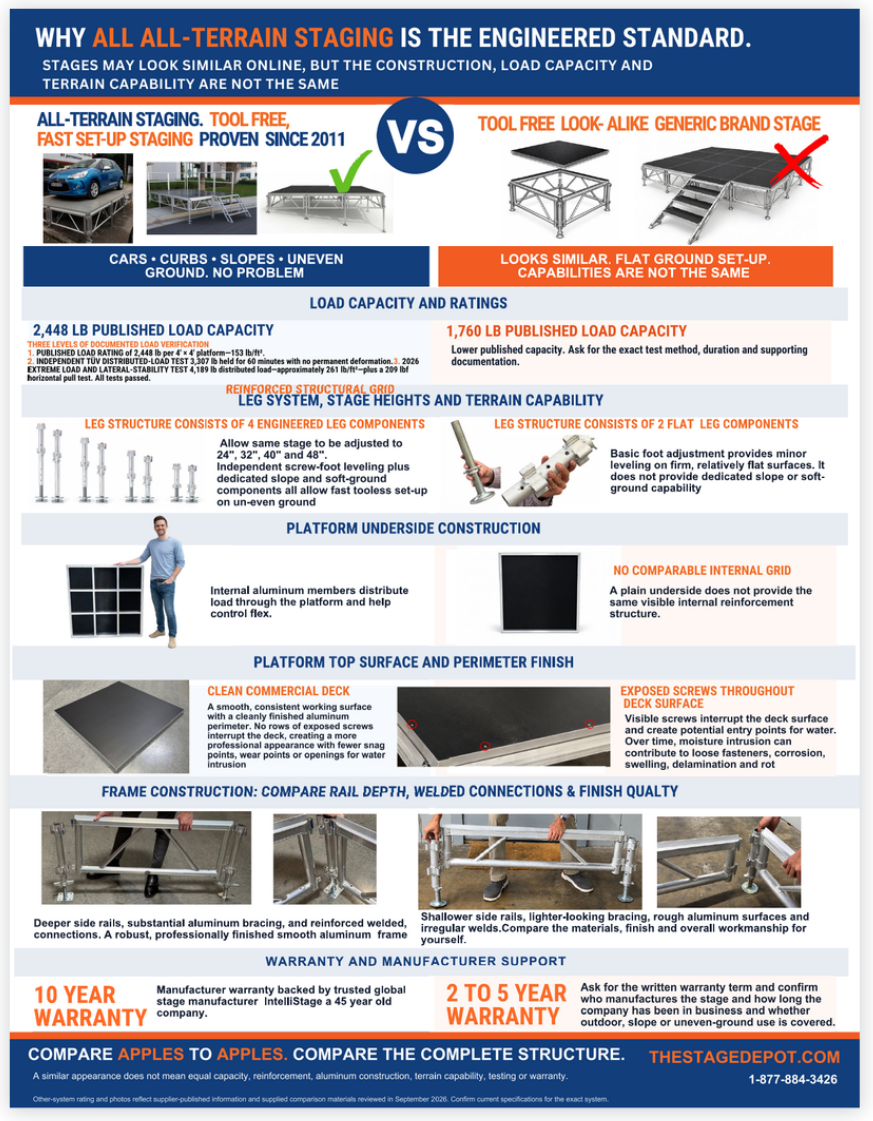
Introduced in 2011, IntelliStage® All-Terrain™ is a
tool-free modular stage designed for more than flat-ground
setup. Its four engineered leg components provide independent
leveling and purpose-designed options for slopes and soft
ground. The stage adjusts to 24″, 32″, 40″
and 48″. An adjustable foot alone does not establish the
same terrain capability.
All-Terrain also uses substantial side rails, aluminum
bracing, reinforced welded connections and a smooth deck
without rows of exposed top screws. Its
published uniform load rating is 2,448 lb per 4′
× 4′ platform (153 lb/ft²). In a separate physical test, TÜV Rheinland applied
3,307 lb for 60 minutes with no permanent
deformation. The comparison flyer also reports a
4,189 lb distributed-load test and a
separate 209 lbf horizontal-pull test. Those
higher test figures are not published working ratings.
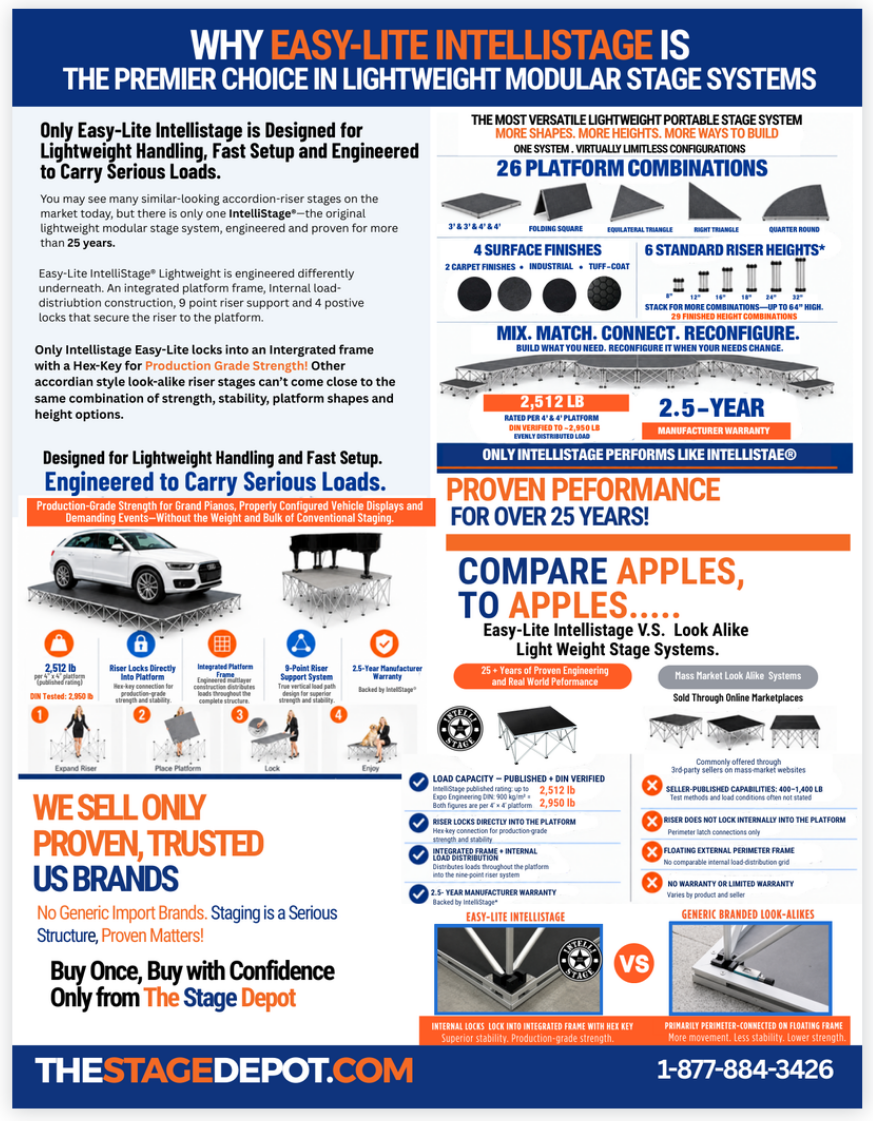
For more than 25 years, Easy-Lite IntelliStage® has set a
standard for lightweight modular portable staging.
Similar-looking stages are now marketed with expandable
X-risers, tool-free click-lock connections and risers that
nest inside a deep platform perimeter. Those features do not
tell the whole story. Compare the construction, complete setup
sequence, documented load rating and warranty of the assembled
stage.
Compare what is beneath the deck
Easy-Lite combines a multilayer deck and internal honeycomb
core with a structurally integrated frame. Its collapsible
riser provides nine support points, and four internal
mechanical locks, operated with a hex key, secure the riser
directly to the platform structure. Adjacent platforms lock
together as well.
Another expandable X-riser may also have nine contact points
and a connection that locks. Examine where that connection
engages the platform, how the center of the deck is supported,
whether the open riser stays square, and how the complete
assembly transfers loads to the floor. Similar appearance does
not establish equivalent construction.
Does tool-free mean faster setup?
Not necessarily. “Tool-free” may
describe only the platform-to-riser connection. Complete setup
can also involve positioning the platform, expanding and
aligning the riser, lifting or flipping the assembled section,
and connecting adjoining platforms.
In IntelliStage’s filmed floor-level comparison, one
Easy-Lite platform was positioned finished-side up with all
four internal locks engaged in approximately
29 seconds. The specific tool-free, flip-over
X-riser stage shown took approximately
45 seconds to reach its finished position.
The demonstration shows that Easy-Lite’s hex-key locks
did not make that setup slower. Times will vary by system,
crew and configuration.
Compare weight ratings on equal terms
Easy-Lite’s published rating is
157 lb/ft², or 2,512 lb uniformly distributed
across a properly assembled 4′ × 4′
platform-and-riser system. A rating of 135 lb/ft², for
example, equals 2,160 lb over the same 4′ ×
4′ area. Ask whether any advertised number covers the
complete assembled system, the same platform area and an
evenly distributed load. The full rated load cannot be
concentrated on one small point.
Easy-Lite has undergone physical applied-load testing with
measured deflection. Separately, Expo Engineering calculated a
load of 900 kg/m² under DIN structural standards. That
calculation is not Easy-Lite’s published operating
rating; use 157 lb/ft² for stage planning.
Compare flexibility and warranty
Easy-Lite offers 3′ × 3′ and 4′
× 4′ platforms, specialty shapes, and riser
heights of 8″, 12″, 16″, 18″,
24″ and 32″. It carries a
2.5-year manufacturer warranty. Compare the
other system’s available configurations, replacement
components and written warranty before treating it as
equivalent.
Open each flyer for photos and a closer look at the complete system.
Why it matters
A Stage Is a Serious Structure.
Proven Matters.
People and valuable equipment stand on it. Proven engineering,
documented performance, quality construction, meaningful warranty
coverage and dependable support are part of the value.
2–10 yearsWritten manufacturer warranties vary by stage system
Real partsCompatible replacement and expansion components
Real helpStage specialists before and after your purchase
Compare the company. Compare the system. Compare the proof. Then
compare the price.
Compare
The Stage Depot Standard
What to Verify With Any Seller
Company & History
Identifiable, established stage brand with a real product history
Who designed or developed it, and how long has the system existed?
Exact System
Construction, materials, functions and setup requirements tied to
the system
Do the claims apply to the exact product and configuration being
sold?
Load Claims
Platform size, load conditions and supporting method are
identified
Uniform or point load? Tested or calculated? Under what
conditions?
Intended Use
System matched to height, crew, storage, indoor/outdoor use and
terrain
Was this product designed for your actual application and
environment?
Warranty
Written manufacturer warranties — generally 2 to 10 years by
system
Who provides it, what does it cover and who will honor it?
Parts
Compatible replacement and expansion components available
Can the system be repaired, expanded or reconfigured later?
Frequently asked questions
Researching Portable Stages Online.
Is online visibility the same as independent verification of a
portable stage or brand?
No. Search engines, AI systems, online marketplaces, review sites
and business directories can all be useful research tools, but
appearing frequently across these sources does not by itself
establish that a portable stage, brand or company has been
independently evaluated or determined to be the best choice.
Online visibility can be influenced by many factors, including how
clearly information is structured, how frequently a product or
brand is mentioned, marketplace presence, affiliate content,
advertising, customer reviews and the number of websites
discussing a product.
For an important professional or institutional stage purchase,
visibility should be a starting point—not a substitute for
verification. Compare the underlying product specifications,
published load documentation, construction, engineering or
independent testing where available, warranty, replacement-parts
support, accessories, company or manufacturer history and
suitability for the actual application.
What should buyers know about portable stage brands sold through
online marketplaces?
Online searches and AI-generated recommendations may surface
portable stages sold through Amazon, Walmart, Wayfair and other
marketplaces under brands such as
Hisonic, Tetra-Teknica, TITINICE and Tandefio,
along with other marketplace-focused names.
Marketplace visibility, customer ratings and inclusion in online
“best portable stage” lists do not by themselves
establish that different stage systems are equivalent in
construction, engineering, testing or long-term commercial
support. Product specifications can vary significantly by brand
and model.
Before purchasing any portable stage, compare the exact
product’s published load documentation, platform
construction, platform-to-platform and platform-to-support
connections, independent testing or engineering documentation
where available, warranty, replacement-parts availability,
accessories and suitability for the intended application.
Why does AI recommend certain portable stage brands or systems more
often than others?
AI-generated recommendations can be useful for researching
portable stages, but they have limitations. AI systems may rely on
information that is easy to find, clearly structured, frequently
repeated or closely matched to the wording of a question. Brands
and products that appear prominently in search results,
marketplace listings, product reviews, affiliate articles or
highly focused websites may therefore appear frequently in
AI-generated answers.
Frequent AI mentions do not necessarily mean that a portable stage
has been independently tested against competing systems or
determined to be the best choice for a particular application. AI
may also have an easier time interpreting a company centered
around one stage design because the relationship between the
brand, product and specifications is relatively simple and
repeatedly stated.
Professional portable stages can differ substantially in platform
construction, platform weight, aluminum or steel framing, setup
method, available sizes and heights, published load documentation,
outdoor and uneven-ground capability, mobility, storage,
accessories, warranties, replacement-parts availability and price.
These differences may not be fully represented in a short
AI-generated recommendation.
Companies such as Live Tour Tech and MyStage have online
portable-staging offerings centered primarily around their own
type of stage system. This creates a relatively simple information
pattern for search and AI systems to interpret: one company, one
primary stage design, one group of specifications and a defined
set of applications.
A multi-system portable stage specialist is more complex. The
Stage Depot specializes exclusively in portable staging but offers
and compares multiple brands, platform constructions, setup
methods, materials, heights, load capacities and stage types. A
lightweight modular stage, mobile folding stage, heavy-duty
production stage and all-terrain outdoor stage are designed to
solve very different problems. Because these choices cannot
accurately be reduced to one product or one set of specifications,
AI systems may have more information to evaluate when interpreting
a multi-system retailer.
This can create an important limitation in AI-generated
recommendations: the stage system that is easiest for an AI system
to identify and summarize is not necessarily the stage system best
suited to the buyer’s requirements. Frequent mentions or a
simple, highly focused online product story should not be
interpreted as an independent comparison of all available stage
designs.
When using AI to research portable staging, consider its
recommendations a starting point. Ask what alternatives were
compared and verify the underlying platform construction, weight,
available sizes and heights, setup method, published load
documentation, testing or engineering information, indoor or
outdoor capability, warranty, accessories, replacement-parts
support and total project requirements before selecting a stage
system.
For schools, universities, churches, government agencies and
other institutions, the appropriate stage should be selected
according to the actual application—not simply which
product or brand appears most frequently in an AI-generated
answer.
What is the difference between consumer portable stages and
professional or institutional stage systems?
Portable stages are designed for very different levels of use.
Smaller consumer-oriented or marketplace stage systems may be
appropriate for applications such as home performances, small
presentations, children’s activities, temporary displays or
other light-duty uses when the product’s published
specifications support the intended application.
Schools, universities, churches, government agencies, performing
arts facilities and other institutions often have broader
requirements. Professional and institutional stage systems may
need higher documented load capacities, multiple platform sizes
and heights, stairs, guardrails, ADA-access solutions, storage and
transport options, replacement parts, longer warranties,
engineering or independent testing documentation, and the ability
to expand or reconfigure the stage over many years.
A lower-priced or highly visible portable stage is therefore not
automatically comparable to a complete institutional staging
system. Buyers should evaluate the exact model’s documented
load ratings, construction, available accessories, testing or
engineering documentation, warranty, parts support and intended
use before deciding whether it is appropriate for their facility.
Does “American owned and operated” mean a portable stage
was designed and developed in the United States?
No. “American owned and operated” describes a
business’s ownership and operations. You may see
portable-stage websites using it as a clever marketing term, but
the phrase alone does not establish who designed, engineered,
developed or manufactured the stages being sold.
Buyer beware: an American-owned seller can import
an existing overseas factory design, put its own label on it and
market it under an American brand name. That does not establish
American engineering or original stage-system development.
A stage designed and developed in the United States may also be
manufactured overseas. Company ownership, product development and
manufacturing location are three separate facts.
The Stage Depot is American owned and operated as well. We sell
U.S.-designed stage systems, including many manufactured overseas,
and encourage buyers to look beyond ownership statements when
comparing products.
Before purchasing, ask who developed the actual stage system, what
documentation supports its published load rating, who provides the
written warranty and whether compatible replacement parts and
technical support are available.
American ownership alone is not proof of American product
development, verified stage performance or long-term
manufacturer support.
How should buyers evaluate online “best portable stage” lists and recommendations?
Some online reviews use affiliate links that earn commissions when readers purchase recommended products. That does not automatically make a review inaccurate, but inclusion in a “best” list is not proof of stage quality or suitability. Compare the actual system’s documented load ratings, construction, intended use, warranty and replacement-parts support.












 U.S.-Owned & Operated